Author: RAFAEL IOSCHPE

  • From Evidence to Decisions: How AI Can Help Pharma Reach Better Development Decisions Earlier

    A practical framework for earlier program-development decisions on when to stop, pivot, learn—or accelerate

    Published August 23, 2026 · 22 min read · 9 figures · 20 references

    In an earlier article, I argued that artificial intelligence could progressively transform Pharma into an evidence industry – one in which competitive advantage increasingly depends on the ability to generate, connect, interpret and validate evidence faster.

    That transformation is already under way. AI is being applied to quantitative pharmacology, Model-Informed Drug Development (MIDD), disease-progression modeling, clinical-trial prediction and multimodal evidence integration. Recent scientific literature increasingly describes AI and MIDD as complementary rather than competing approaches. [1–4]

    But there is a harder question behind the idea of Pharma becoming an evidence industry:

    What happens after the evidence is generated?

    More data do not automatically produce better decisions. More frequent interim analyses do not necessarily identify emerging problems earlier if the information being collected remains insufficiently discriminative. An AI model capable of processing biologically ambiguous evidence faster may therefore accelerate analysis without materially reducing the uncertainty surrounding the development decision.

    An evidence industry without a decision-architecture risks becoming a data industry.

    The opportunity explored here is not primarily to build an AI capable of deciding which drug should live or die. It is to design clinical development so that evidence capable of changing a decision becomes available earlier – and then determine where AI can help find, integrate, interpret and challenge that evidence without obscuring scientific accountability.

    Two different problems: Evidence Latency and Decision Latency

    When emerging evidence begins to reduce confidence in a development program, familiar responses include additional interim analyses, adaptive designs, futility criteria and more frequent data reviews.

    All can be valuable.

    But consider a program in which the clinically discriminative readout appears only after 18 months. Reviewing the trial at months 6, 9 and 12 may simply provide three earlier views of information that is still incapable of answering the critical development question.

    In this article, Evidence Latency is defined as:

    the time between a critical development hypothesis and the point at which sufficiently informative evidence becomes available to materially change a development decision.

    A second bottleneck, Decision Latency, is defined as:

    the time between sufficiently informative evidence becoming available and an accountable development action.

    These are descriptive constructs rather than standardized regulatory terms. Their value lies in separating two problems that require different solutions.

    Evidence Latency is predominantly an information problem. Biomarkers, longitudinal measurements, PK/PD, disease models, MIDD, Bayesian inference and AI may help shorten it.

    Decision Latency is predominantly a decision-design and governance problem. Predefined decision boundaries, explicit ownership, structured overrides, independent challenge and mandatory reassessment become more relevant.

    AI may help compress Evidence Latency. It cannot, by itself, resolve Decision Latency.

    Flow from critical hypothesis to observable signal, decision-grade evidence, scientific review and action, distinguishing Evidence Latency from Decision Latency.
    Figure 1. Drug Development Has Two Different Latency Problems. Select the figure to view it at full size.

    Three development cases, three different decision problems

    The distinction becomes clearer through three real development examples. They were not selected as “AI success stories.” Their value is precisely that they show how quantitative evidence and development architecture can alter decisions even before AI is introduced.

    Pfizer / domagrozumab – when early evidence and later investment decisions diverge

    Domagrozumab was an anti-myostatin monoclonal antibody developed for Duchenne muscular dystrophy. Pfizer prospectively evaluated an anabolic proof-of-mechanism signal through change in lean body mass using a Bayesian decision framework.

    The early study demonstrated pharmacological activity, but the evidence did not reach the level prospectively defined as sufficient for success. Pfizer nevertheless proceeded to a larger Phase II proof-of-concept study. In the company’s subsequent analysis of R&D productivity, the authors described competitive considerations and the importance of maintaining development momentum as factors contributing to the decision. The Phase II study subsequently failed to demonstrate the anticipated clinical efficacy, and development was discontinued. The authors later suggested that a smaller Early Signal of Efficacy study might have addressed the relevant development question earlier. [5]

    This should not be interpreted as evidence that a quantitative criterion should mechanically determine the future of an asset. Development decisions legitimately integrate scientific, clinical, competitive and strategic information that may extend beyond an individual model.

    The broader lesson is more subtle. When emerging evidence diverges from prospectively established expectations, the development process should make the next question explicit:

    What new information justifies changing the original interpretation?

    Earlier evidence only creates value if there is a structured and traceable way to determine how that evidence influences the next development gate.

    GSK / depemokimab – how much is the next experiment worth?

    Depemokimab presents almost the opposite problem.

    Rather than determining whether a program with weakening evidence should stop, GSK needed to determine whether a promising program still required a conventional Phase II dose-ranging step.

    The program benefited from an unusually mature evidence base. IL-5 biology was well established; GSK had substantial prior clinical experience with mepolizumab; blood eosinophils provided an informative pharmacodynamic measure; and Phase I data could be interpreted through an established PK/PD relationship.

    GSK integrated this information using MIDD and a quantitative decision-making framework. Advancement criteria were defined prospectively using Minimum and Target Values informed by prior mepolizumab data. A Bayesian PK/PD model was then used to estimate whether the proposed depemokimab regimen would achieve the intended pharmacodynamic response. [6]

    The development team then addressed a different question: how much information would a conventional Phase IIb efficacy dose-ranging study actually add to the Phase III dose decision?

    According to the published simulations, such a study had less than a 3% probability of providing a more precise estimate for the Phase III regimen than the pharmacology-based approach. The authors estimated that the strategy reduced the development timeline by approximately two to three years. [6]

    The generalizable lesson is not that Phase II can routinely be bypassed. Depemokimab had unusually favorable conditions: established biology, previous class experience, an informative biomarker, an existing safety evidence base and substantial quantitative-development capability.

    The value of the next experiment should be judged by how much it is expected to improve the next decision.

    That is fundamentally different from asking whether another study can be performed. It is a Value-of-Information question.

    Roche/Genentech / IMbrave151 – extracting information before the endpoint matures

    The randomized Phase II IMbrave151 trial in advanced biliary tract cancer presented a third problem: overall survival had not yet matured sufficiently to support the desired development decision.

    Investigators applied a previously developed tumor-growth-inhibition-overall-survival model to early longitudinal tumor dynamics. At an interim analysis with 98 patients and approximately 27 weeks of follow-up, the model estimated an OS hazard ratio of 0.74. When survival data later matured, the observed hazard ratio was 0.76. The authors described this as the first prospective use of their TGI-OS framework to support a Phase III development gate. [7]

    The innovation was not another early look at the same endpoint. It was the use of an earlier longitudinal signal to update expectations for an outcome that had not yet matured.

    When the definitive endpoint is late, which earlier observations can credibly update the probability that the program will ultimately succeed?

    This is where reducing Evidence Latency becomes an operational strategy rather than simply a new expression.
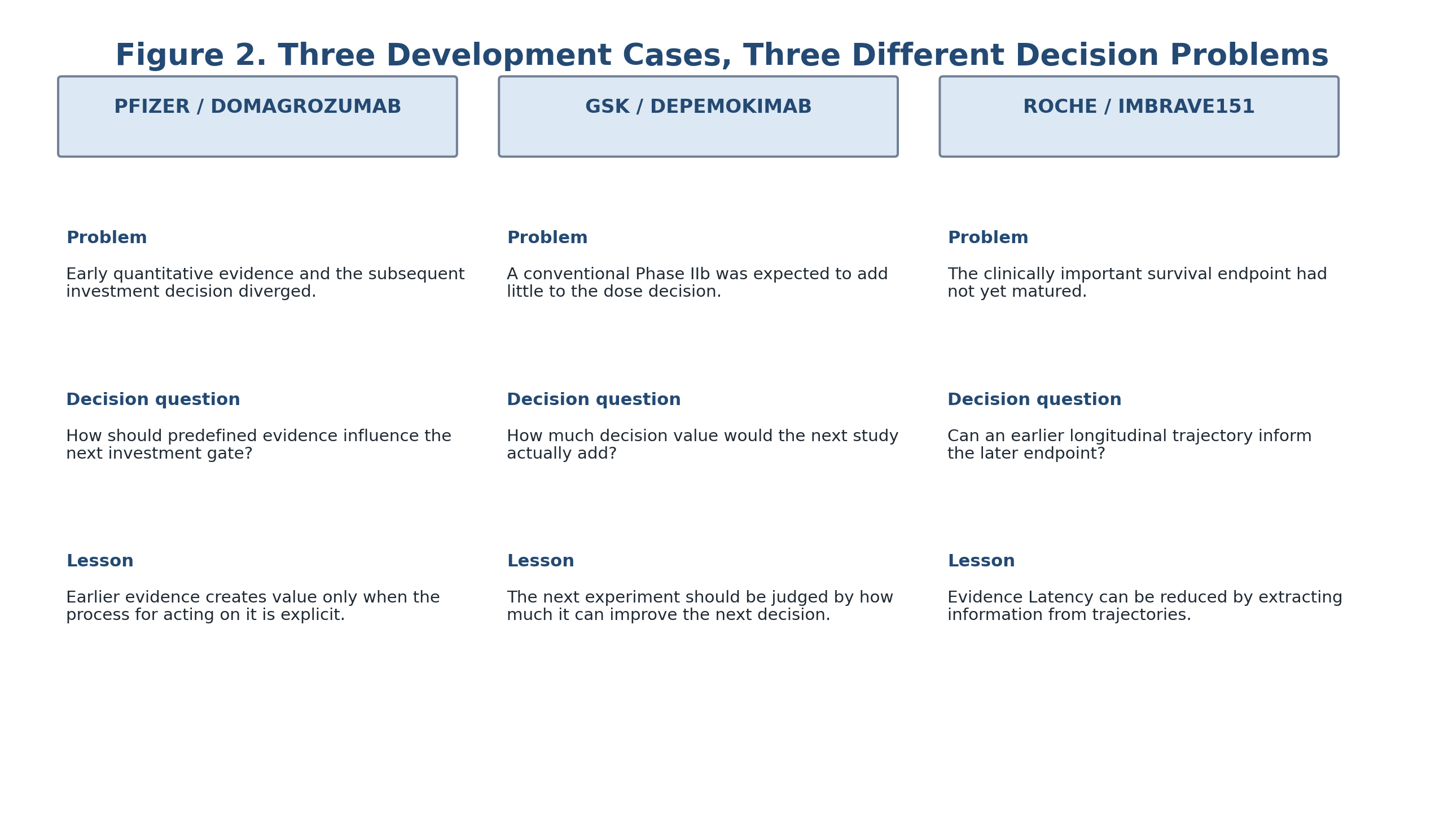
    Comparison of Pfizer domagrozumab, GSK depemokimab and Roche IMbrave151, showing each program's problem, decision question and development lesson.
    Figure 2. Three Development Cases, Three Different Decision Problems. Select the figure to view it at full size.

    The common objective is earlier discrimination among programs that should STOP, PIVOT, LEARN, ENRICH, CONTINUE or ACCELERATE.

    Start with the decision, not with the AI

    Before choosing an algorithm, a development program should define what must remain true for continued investment and what evidence could materially weaken those assumptions.

    This principle has a clear scientific lineage.

    Falsifiability is a well-established concept in the philosophy of science, most prominently associated with Karl Popper: a scientific hypothesis must, in principle, be open to empirical refutation. Pharmaceutical development has long applied related ideas using more familiar terminology – proof-of-mechanism, fast-fail, quick-kill, Go/No-Go criteria, futility analyses and stage gates. The NIMH Fast-Fail program, for example, was explicitly designed around biomarker-based proof-of-mechanism in early clinical development. [8,9]

    Rather than describe the entire approach as a “Falsification Framework,” a more operational construct is:

    Prospective Evidence-to-Decision Framework

    Falsifiability is one of its principles. The framework links each critical development assumption prospectively to evidence capable of changing the development response.

    Framework linking eight critical drug-development questions with decision-relevant evidence and potential responses such as reassess, pivot, learn, accelerate or stop.
    Figure 3. Prospective Evidence-to-Decision Framework. Select the figure to view it at full size.

    The value of the framework lies in defining the critical questions, evidence requirements and potential decision responses before the answer is known.

    Only then should the organization ask where AI can improve the process.

    Four practical ways to reduce Evidence Latency

    Simply collecting more biomarkers does not constitute a new development strategy. A more useful approach is to design the program around the earliest information capable of materially changing confidence in eventual success.

    This process can be organized around four complementary strategies.

    1. Endpoint Back-Translation

    Development often begins with the ultimate clinical outcome and waits until that outcome becomes measurable.

    Endpoint Back-Translation reverses that logic.

    Start with the outcome required for the program to succeed and work backward through the causal chain. In the sequence below, the arrows indicate the direction of back-translation, not the biological causal direction:

    Required late clinical outcome → required earlier clinical trajectory → required biological response → required pathway modulation → required target engagement → required exposure

    The key question becomes:

    Which is the earliest link whose failure would materially reduce confidence in the final outcome?

    Depemokimab illustrates part of this logic. The dosing decision did not require every downstream clinical question to be resolved because prior evidence allowed the exposure-pharmacodynamic relationship to carry substantial information for that specific Context of Use.

    Endpoint Back-Translation does not assume that an earlier signal can substitute for the definitive clinical endpoint. Its purpose is to identify the earliest measurable requirement in the causal chain whose failure would materially weaken the later clinical hypothesis.

    2. Map the Falsifiability Horizon

    Each critical development assumption has a different earliest point at which it can be tested meaningfully.

    This article refers to that interval as the Falsifiability Horizon:

    the earliest point at which a critical program assumption can be evaluated with evidence sufficiently informative to influence a development decision.

    The horizon varies across the causal chain: exposure may become informative within days, target engagement within days or weeks, biological trajectories over weeks or months, while definitive clinical efficacy may require months or years.

    Importantly, Falsifiability Horizon is assumption-specific, not only disease-specific. A therapeutic area may have a long horizon for definitive clinical efficacy and a much shorter one for exposure, target engagement, pathway modulation or another upstream question.

    Trontinemab illustrates this distinction in Alzheimer’s disease, where meaningful cognitive benefit remains a late clinical readout. In its Phase Ib/IIa Brainshuttle AD study, Roche observed rapid, dose-dependent amyloid-PET reduction together with changes in downstream CSF and plasma biomarkers, including pTau217, and announced progression to Phase III based on the totality of data. Roche later described accelerated Phase III decision-making based on biomarker proof-of-concept as part of a fast-track strategy estimated to shorten time to filing by 21 months; modeling from the Phase Ib/IIa study also informed the Phase III dosing regimen. The clinical Falsifiability Horizon therefore remained long, while upstream exposure, amyloid-removal and biomarker-response questions became decision-relevant earlier. Reducing Evidence Latency does not require making the definitive endpoint mature sooner; it can mean moving the decision upstream in the causal chain when the Context of Use allows it. [16–18]

    Development planning should therefore consider not only conventional study milestones, but also the earliest point at which each critical assumption becomes meaningfully testable.

    3. Optimize the next readout for information value

    The next analysis should not occur only because the protocol specifies “Week 12.”

    Which next observation is most likely to move the decision?

    Depending on the program, that could be receptor occupancy, a PK/PD relationship, ctDNA, imaging, a molecular signature, a digital measurement – or simply additional follow-up.

    An observation may be scientifically interesting while having little decision value. Conversely, a relatively simple measurement can be extremely valuable if it materially changes the probability of crossing a predefined development boundary.

    The GSK case makes this distinction concrete. The issue was not whether a Phase II study would generate additional data; it clearly would. The question was whether those data were sufficiently likely to improve the decision to justify obtaining them.

    4. Look for Multi-Signal Convergence

    The future of early development is unlikely to depend on finding one universal “magic biomarker.”

    A more realistic opportunity is to determine whether partially independent signals are converging toward – or away from – the development hypothesis. Relevant signals could include:

    • exposure

    • target engagement

    • pathway modulation

    • imaging

    • molecular trajectories

    • early clinical measurements

    No single signal may be sufficient. Collectively, however, they may materially alter confidence in the causal chain.

    This is one area where AI may provide genuinely new capability: integrating heterogeneous, longitudinal and partially independent signals at a scale that is difficult to reproduce through serial human review.

    Four levers—Endpoint Back-Translation, Falsifiability Horizon, information-optimized readout and multi-signal convergence—mapped onto the clinical causal chain.
    Figure 4. Four Practical Levers to Reduce Evidence Latency. Select the figure to view it at full size.

    Note: The lower sequence is shown in the biological causal direction; the upper arrow indicates the direction of Endpoint Back-Translation.

    Evidence Latency is reduced when development is designed around the earliest informative decision signal – not simply around more frequent analyses.

    Applicability depends on the biology of the therapeutic area

    The decision architecture can be applied broadly, but its ability to generate early decision-grade evidence depends on how observable the causal chain is and how long critical assumptions take to become testable. Signal Observability describes how directly and frequently the sequence between drug exposure and clinical benefit can be measured, while Falsifiability Horizon describes the earliest point at which a specific assumption becomes decision-relevant. Because these properties differ across mechanisms and endpoints, applicability varies substantially across and within therapeutic areas.

    Table comparing early-decision applicability, earlier observable signals and principal constraints across nine therapeutic areas.
    Figure 5. Relative Applicability by Therapeutic Area. Select the figure to view it at full size.
    Comparison of the observable causal chains for trontinemab in Alzheimer's disease and NXT007 in hemophilia A, illustrating different falsifiability horizons.
    Figure 6. Same Framework, Different Observable Causal Chains. Select the figure to view it at full size.

    The contrast shown in Figure 6 illustrates why the horizon should not be assigned at therapeutic-area level alone. In hemophilia A, the Phase I/II NXTAGE program for NXT007 linked dose-dependent exposure to predicted FVIII-equivalent activity and bleeding outcomes. Predicted FVIII-equivalent activity reached the nonhemophilic range from cohort B2 onward, while the mean annualized treated bleeding rate was 0.00 in the B3 and B4 cohorts. Chugai subsequently advanced the program into Phase III, with two Phase III studies initiated by July 2026. Compared with Alzheimer’s disease, several links in this causal chain are more directly observable, allowing multiple development assumptions to become decision-relevant earlier. [19,20]

    The NIMH Fast-Fail experience illustrates the distinction. In psychiatry, where reliable early efficacy prediction can be difficult, the development question was shifted toward proof-of-mechanism and whether target engagement altered the hypothesized neural circuitry. [9]

    When efficacy cannot be tested early, mechanism sometimes can.

    AI does not remove these biological limitations. It cannot create an informative early signal when the biology does not make one observable.

    Where AI actually adds value

    The phrase “use AI” is too broad to guide a development strategy. Different decision problems require different AI architectures.

    Evidence AI

    LLMs combined with retrieval-augmented generation and governed knowledge bases can search and connect internal study reports, external literature, competitor results, regulatory evidence and biological knowledge.

    The relevant question is not merely what supports a program, but what new evidence has emerged that materially weakens one of its critical assumptions.

    This creates the possibility of a continuously operating Scientific Red Team – not empowered to stop a program, but designed to reduce the risk that contradictory evidence is systematically overlooked.

    Pattern AI

    Longitudinal and multimodal machine-learning methods can examine trajectories across imaging, laboratory data, ctDNA, omics, digital measurements and clinical observations.

    These systems are particularly relevant to Multi-Signal Convergence. Their purpose is not simply to maximize predictive accuracy, but to determine whether independent signals are coherently changing the interpretation of the development hypothesis.

    Predictive AI

    AI/ML models are already being developed to predict Phase II outcomes, clinical-trial termination and eventual drug approval. Aliper et al., for example, described a multimodal platform incorporating target biology, trial design and other information to predict clinical-trial outcomes. [10]

    These models can provide useful portfolio intelligence. However, predicting failure is not equivalent to understanding why confidence in a program is declining.

    A study may terminate for operational, financial, strategic, safety or efficacy reasons. A prediction model may also learn relationships from sponsor characteristics or study design that are genuinely predictive without directly interrogating the therapeutic mechanism.

    For that reason, a single opaque AI-derived Probability of Success should not become the sole decision output.

    The underlying confidence structure matters.

    Decision-confidence model separating scientific, clinical, development and decision confidence instead of relying on one opaque probability of success.
    Figure 7. Decision Confidence Should Be Decomposed. Select the figure to view it at full size.

    A composite Probability of Success may remain useful as a summary. It should not obscure which component changed, by how much, and why.

    Hybrid mechanistic + AI models

    For high-stakes clinical-development decisions, hybrid architectures may be particularly attractive.

    PK/PD, PBPK, disease-progression and quantitative-systems-pharmacology models encode biological and pharmacological structure. AI can add pattern recognition, nonlinear relationships and additional dimensions without necessarily discarding mechanistic interpretability.

    This direction is consistent with the broader AI-MIDD literature, which increasingly argues for complementarity between data-driven and model-informed methods rather than replacement of one by the other. [1–4]

    For a high-impact development decision, interpretability can be an asset rather than a technological limitation.

    Decision Latency requires an operating model

    Once sufficiently informative evidence exists, the nature of the problem changes.

    Because Decision Latency is primarily a process and governance problem, reducing it requires explicit operating mechanisms for translating evidence into action. Four are particularly relevant: predefined decision boundaries, structured overrides, independent challenge and mandatory re-review.

    Predefined decision boundaries establish prospectively which forms of evidence should trigger reconsideration of the program and which potential responses – STOP, PIVOT, LEARN, ENRICH, CONTINUE or ACCELERATE – should formally enter the discussion.

    Structured override preserves scientific judgment without allowing quantitative criteria to disappear once the result becomes uncomfortable. Leadership may legitimately depart from a prospectively defined rule, but the evidence and rationale supporting that departure should become explicit.

    Independent challenge introduces a function capable of testing the interpretation without being directly dependent on the program’s progression. Its role is not to advocate for termination, but to challenge assumptions, alternative explanations and selective interpretations of the evidence.

    Mandatory re-review prevents LEARN or CONTINUE from becoming indefinite states. When meaningful uncertainty remains, the organization should define which new information is expected, when it should become available and when the next formal decision will occur.

    Operating model of predefined boundaries, structured override, independent challenge and mandatory re-review leading from sufficient evidence to accountable action.
    Figure 8. Four Operating Mechanisms to Reduce Decision Latency. Select the figure to view it at full size.

    AI may accelerate evidence availability, but decision rights, exception handling and review discipline determine how quickly an organization acts. Together, these mechanisms address Decision Latency as what it primarily is: a process and governance problem, ensuring that unresolved uncertainty returns to a defined decision point.

    Traceability may become an advantage, not only a constraint

    The need for traceability is not unique to drug-development AI, and experience elsewhere in healthcare provides a useful caution.

    In a widely deployed U.S. population-health algorithm, Obermeyer and colleagues found that healthcare cost had been used as a proxy for health need. Because spending reflected differences in access and utilization, Black patients with the same algorithmic risk score were, on average, substantially sicker than White patients. The authors estimated that correcting the bias would increase the proportion of Black patients identified for additional care from 17.7% to 46.5%. [11]

    This was not a drug-development case, and it should not be interpreted as one. Its relevance is methodological: a model can be technically predictive while still optimizing a proxy that is misaligned with the real decision objective.

    For clinical development, that means traceability is not merely a compliance requirement. It is part of determining whether a model is answering the right question, using the right evidence and supporting the intended Context of Use.

    Current regulatory thinking is moving in the same direction. FDA’s draft AI guidance uses a risk-based credibility framework tied to a clearly defined Context of Use, while the joint FDA-EMA Good AI Practice principles emphasize human-centric design, data governance and documentation, performance assessment and lifecycle management. Final ICH M15 similarly establishes a harmonized framework for planning, evaluating and documenting MIDD evidence, including AI/ML approaches within its scope. [12–14]

    These principles argue against:

    data → black-box AI → STOP

    A more defensible architecture is:

    data → traceable evidence → fit-for-purpose model → prediction + uncertainty → scientific interpretation → accountable decision

    Properly designed AI may therefore make some development decisions more “reconstructable”, not less.

    A conventional portfolio decision may emerge from multiple analyses, presentations, expert discussions and management judgment. Years later, reconstructing exactly what was known and why a particular decision was made can be difficult.

    An AI-augmented process can preserve Decision Provenance.

    Traceable chain from evidence snapshot through analytical layer, model output, human interpretation and decision to a documented decision record.
    Figure 9. Decision Provenance. Select the figure to view it at full size.

    The objective is not to eliminate judgment. It is to make judgment reconstructable.

    Implementation should start with decision maturity – not AI maturity

    A company does not need a large AI organization to begin improving these decisions.

    The logical sequence is more likely to be:

    Decision discipline → Quantitative development → Integrated evidence → AI augmentation → Portfolio intelligence

    The importance of organizational maturity is increasingly supported by industry evidence. A 2026 Pistoia Alliance analysis drawing on workshops, executive surveys and AI/ML use cases concluded that organizational capability and project maturity were important determinants of successful AI deployment, while reproducibility, explainability and governance remained relevant constraints in higher-risk applications. [15]

    This suggests that the relevant capability is broader than AI maturity.

    It is Quantitative Development Maturity.

    That capability sits across Clinical Development, Translational Medicine, Clinical Pharmacology, Pharmacometrics, Biostatistics, Data Science, Regulatory, Quality and Portfolio Governance.

    An organization considering implementation could begin with a limited number of programs in which the biological chain is reasonably observable, historical evidence exists, critical decisions can be explicitly defined and model outputs can initially operate in shadow mode, without influencing active decisions.

    Only after demonstrating calibration, stability and genuine decision utility should AI progress into assisted decision-making.

    Earlier discrimination enables better portfolio prioritization

    Earlier discrimination creates strategic value by helping an organization recognize sooner when evidence supporting a program is weakening, when uncertainty can be resolved through targeted learning, and when converging evidence justifies greater commitment. The purpose is not simply to reach a faster stop/go decision; it is to improve allocation of capital, development capacity and management attention across the portfolio.

    Weakening evidence → REASSESS / PIVOT / STOP; reallocate resources
    Material uncertainty → LEARN / ENRICH before further commitment
    Converging evidence → PRIORITIZE / CONTINUE / ACCELERATE

    Together, the Pfizer, GSK and Roche cases illustrate three distinct development challenges: how emerging evidence should influence the next investment gate, whether an additional study is worth conducting, and whether an earlier trajectory can meaningfully inform a later endpoint. AI can potentially strengthen each of these processes, but only after the underlying development questions and decision criteria have been made explicit.

    From an evidence industry to a decision-ready organization

    AI is increasing Pharma’s capacity to generate, connect and interrogate evidence. The framework explored here suggests, however, that evidence generation alone is unlikely to become the decisive competitive advantage.

    A decision-ready organization would first identify the assumptions on which a development program depends, determine how early each assumption can become meaningfully testable, define which evidence could alter the development path, and establish how much additional information is worth acquiring before the next decision.

    Quantitative methods and AI can then be deployed where they create measurable value: shortening the path from an emerging signal to decision-grade evidence, integrating information that would otherwise remain fragmented, updating predictions as new evidence accumulates and continuously challenging the assumptions on which the program depends.

    Governance completes that architecture. The final decision remains human, while the evidence, uncertainty, analytical contribution and rationale remain reconstructable through Decision Provenance.

    This brings the argument back to a conclusion I reached in an earlier article, The Pharma Market doesn’t have an AI problem. It probably has a process problem.

    The same issue appears here in a more specific form.

    If clinical-development workflows, decision rights, evidence flows, review processes and governance remain unchanged, AI may accelerate individual analyses without materially improving the quality or timing of the development decision. Implementing AI in clinical development is therefore not only a technology challenge. It is also a change-management challenge: processes, incentives, responsibilities and decision policies must evolve with the tools.

    This does not diminish the potential of AI. It clarifies where that potential can actually be realized.

    The opportunity is not to let AI decide earlier. It is to build an organization capable of reaching the right decision earlier, with stronger evidence, explicit accountability and a clear understanding of how and why that decision was reached.

    In that model, AI becomes what it should be: an accelerator of evidence and decision quality – not a substitute for scientific judgment.

    And if Pharma is indeed becoming an evidence industry, the competitive advantage may ultimately belong not to the company producing the most evidence, but to the one capable of determining which evidence matters, recognizing it earlier, acting on it at the right moment – and doing so knowing why.

    References

    1. Barrett JS, Goyal RK, Gobburu J, Baran S, Varshney J. An AI Approach to Generating MIDD Assets Across the Drug Development Continuum. AAPS J. 2023;25:70. doi:10.1208/s12248-023-00838-x. View source
    2. Terranova N, Renard D, Shahin MH, et al. Artificial Intelligence for Quantitative Modeling in Drug Discovery and Development: An Innovation and Quality Consortium Perspective on Use Cases and Best Practices. Clin Pharmacol Ther. 2024;115:658-672. doi:10.1002/cpt.3053. View source
    3. Raman K, Kumar R, Musante CJ, Madhavan S. Integrating Model-Informed Drug Development With AI: A Synergistic Approach to Accelerating Pharmaceutical Innovation. Clin Transl Sci. 2025;18:e70124. doi:10.1111/cts.70124. View source
    4. Mao B, Gao Y, Xu C, et al. Evaluating the Impact of AI-Based Model-Informed Drug Development: A Comparative Review. AAPS J. 2025;27:102. doi:10.1208/s12248-025-01075-0. View source
    5. Fernando K, et al. Achieving end-to-end success in the clinic: Pfizer’s learnings on R&D productivity. Drug Discov Today. 2022;27:697-704. View source
    6. Zecchin C, Schalkwijk S, Pouliquen IJ, et al. Straight to Phase III: Model-Informed Approach Speeds Depemokimab Clinical Development in Interleukin-5-Driven Diseases. Clin Pharmacol Ther. 2026;119:1005-1015. doi:10.1002/cpt.70183. View source
    7. Shemesh CS, Chan P, Marchand M, et al. Early Decision Making in a Randomized Phase II Trial of Atezolizumab in Biliary Tract Cancer Using a Tumor Growth Inhibition-Survival Modeling Framework. Clin Pharmacol Ther. 2023;114:644-651. doi:10.1002/cpt.2953. View source
    8. Popper KR. The Logic of Scientific Discovery. London: Hutchinson; 1959.
    9. Krystal AD, Pizzagalli DA, Smoski M, et al. A randomized proof-of-mechanism trial applying the fast-fail approach to evaluating kappa-opioid antagonism as a treatment for anhedonia. Nat Med. 2020;26:760-768. doi:10.1038/s41591-020-0806-7. View source
    10. Aliper A, Kudrin R, Polykovskiy D, et al. Prediction of Clinical Trials Outcomes Based on Target Choice and Clinical Trial Design with Multi-Modal Artificial Intelligence. Clin Pharmacol Ther. 2023;114:972-980. doi:10.1002/cpt.3008. View source
    11. Obermeyer Z, Powers B, Vogeli C, Mullainathan S. Dissecting racial bias in an algorithm used to manage the health of populations. Science. 2019;366:447-453. doi:10.1126/science.aax2342. View source
    12. U.S. Food and Drug Administration. Considerations for the Use of Artificial Intelligence to Support Regulatory Decision-Making for Drug and Biological Products. Draft Guidance. January 2025. View source
    13. FDA / EMA. Guiding Principles of Good AI Practice in Drug Development. January 2026. View source
    14. International Council for Harmonisation / U.S. Food and Drug Administration. M15 General Principles for Model-Informed Drug Development. Final Guidance. June 2026. View source
    15. Makarov VA, Sänger M, Saiz R, Hartung M, Lynch N. Why Do AI Projects Fail in Drug Development and Pharma? Insights from Multi-Year Pistoia Alliance Studies. J Comput Aided Mol Des. 2026. View source
    16. Roche. Roche presents novel therapeutic and diagnostic advancements in Alzheimer’s at AD/PD 2025. 3 April 2025. View source
    17. Roche. Pharma Day 2025 – Embrace ambitious R&D objectives. Trontinemab fast-track program: accelerated Phase III decision-making based on biomarker proof-of-concept; 21 months faster to filing. September 2025. View source
    18. Roche. Roche presents new data in Alzheimer’s disease from across its integrated pharmaceutical and diagnostics portfolio at AAIC. 7 July 2026. Modeling from the Phase Ib/IIa Brainshuttle AD study informed dosing for Phase III TRONTIER 1 and 2. View source
    19. Nogami K, You C-W, Park Y-S, et al. NXTAGE: a phase 1/2 study of NXT007 to assess safety, pharmacokinetics, and efficacy in hemophilia A without inhibitors. Blood. 2026;147(19):2261-2271. doi:10.1182/blood.2025031894. View source
    20. Chugai Pharmaceutical Co., Ltd. Chugai Announces 2026 2nd Quarter Results. 24 July 2026. Two Phase III studies for NXT007 initiated. View source

    Print-formatted version
    The full article above is the primary, searchable web edition. A 15-page print-formatted version is also available for readers who prefer that format.

  • AI Will Not Eliminate CROs. It Will Redefine What Clients Pay Them For

    The next competitive advantage in clinical development will be patient access, site enablement and evidence quality — not the number of hours billed.

    If artificial intelligence turns pharmaceutical R&D into an evidence industry, every company supporting drug development will need to reconsider what it actually sells.

    For contract research organizations, the question is frequently framed in dramatic terms:

    Will AI replace CROs?

    That is probably the wrong question.

    A more useful one is:

    Which CRO services will continue to command premium prices when much of the administrative, analytical and documentary work can be automated?

    AI is unlikely to remove the need for clinical development partners.

    It may remove the willingness to pay premium fees for work that no longer requires premium expertise.

    Where AI Is Already Automating Clinical Development

    The most visible gains from AI in clinical development are not yet coming from fully autonomous trial design or synthetic replacements for human evidence.

    They are coming from activities that are repetitive, fragmented and information-intensive:

    • protocol digitization;
    • feasibility analysis;
    • site identification;
    • document drafting;
    • clinical data review;
    • coding and programming support;
    • monitoring prioritization;
    • regulatory-document preparation;
    • safety-case processing;
    • study-status consolidation.

    Executives interviewed by Reuters in early 2026 described measurable operational applications.

    Novartis said AI reduced a site-selection exercise for a 14,000-patient cardiovascular study from a process that normally took four to six weeks to a two-hour meeting. The company subsequently completed enrollment only 13 patients above its target.

    GSK reported approximately £8 million in savings from digital and AI-supported enrollment and data processes in late-stage asthma trials and established a goal of accelerating clinical trials by approximately 15%.

    Genmab and ITM described applications in clinical analysis, report generation and regulatory formatting. (Reuters)

    Teva CEO Richard Francis summarized the near-term opportunity as improving “all the unsexy stuff” surrounding the scientific objective of bringing a medicine to market.

    The comment is revealing.

    AI is first attacking the coordination costs of clinical development.

    The earliest disruption is not replacing clinical science. It is reducing the labor required to organize, document and transmit it.

    The Economic Threat to the Billable-Hour CRO Model

    Many traditional CRO contracts are built around:

    • full-time equivalents;
    • hours worked;
    • monitoring visits;
    • documents produced;
    • units processed;
    • duration of support;
    • project-management effort.

    AI reduces precisely those inputs.

    A regulatory document that previously required several writers, reviewers and formatters may be generated and checked with fewer hours.

    A central-monitoring team may review a smaller number of sites because algorithms prioritize the highest-risk signals.

    Clinical data management teams may process fewer manual reconciliations.

    Feasibility assessments may require less time collecting and consolidating historical information.

    This creates an economic contradiction:

    Under a traditional commercial model, a CRO can reduce its own revenue by becoming more productive.

    CROs will therefore need to choose among several responses:

    • retain productivity benefits while selectively reducing prices;
    • move from hourly to unit-based pricing;
    • license technology separately;
    • offer subscription-based intelligence;
    • negotiate milestone or performance incentives;
    • share part of the value created through faster execution;
    • redesign services around higher-value decisions.

    The threat is not that every outsourced activity will return to pharmaceutical companies.

    The threat is that clients will no longer accept large teams and long timelines for activities that technology can substantially compress.

    Financial markets are already debating this issue.

    Shares of IQVIA, Medpace and Charles River came under pressure in early 2026 as investors considered whether advanced AI agents could enable sponsors to internalize more work.

    Industry specialists interviewed by Reuters argued that this interpretation underestimated the physical, regulatory and operational capabilities required to conduct clinical research. (Reuters)

    Both positions contain part of the truth.

    AI will commoditize some services.

    It will also increase the value of capabilities that cannot be digitally replicated.

    Research Sites Are Becoming Scarce Clinical Trial Infrastructure

    AI can generate a protocol.

    It cannot automatically create:

    • an experienced investigator;
    • a trained coordinator;
    • an infusion facility;
    • validated laboratory capacity;
    • access to a rare-disease population;
    • trust between a physician and a patient;
    • local regulatory expertise;
    • reliable adverse-event management;
    • long-term participant retention.

    If AI increases the number of viable development programs, demand for high-performing sites may grow faster than site capacity.

    That turns the research center into one of the most strategically constrained resources in clinical development.

    The consolidated ICH E6(R3) Good Clinical Practice guideline reflects this broader view of clinical trial quality.

    It emphasizes that trial design should be operationally feasible, avoid unnecessary complexity, adapt technology to participant characteristics and incorporate perspectives from patients, communities and healthcare professionals.

    It also reinforces that poorly designed or poorly conducted trials waste the efforts of participants and investigators and may generate unreliable results. (ICH E6(R3))

    This has an important consequence for CROs.

    Selecting a research site will no longer be enough.

    The next competitive frontier will be enabling the site to perform.

    Site selection will become site enablement.

    From Clinical Trial Site Selection to Site Enablement

    Traditional feasibility frequently asks whether a site has access to the required patient population, infrastructure and staff.

    The answers are often based on questionnaires, investigator estimates and historical performance that may not accurately reflect the current environment.

    AI can improve feasibility by combining:

    • electronic health-record signals;
    • epidemiological data;
    • historical enrollment;
    • current competing trials;
    • staff capacity;
    • startup timelines;
    • screen-failure patterns;
    • protocol complexity;
    • geographic and socioeconomic factors.

    But predictive site selection solves only part of the problem.

    Even a correctly selected center may fail if it receives an impractical protocol, too many disconnected systems, inadequate training or insufficient operational support.

    Research Site Capability Assessment

    Before activation, the CRO could evaluate:

    • actual patient availability;
    • investigator and coordinator capacity;
    • therapeutic-area expertise;
    • equipment and laboratory readiness;
    • pharmacy and investigational-product capabilities;
    • technology infrastructure;
    • data-security maturity;
    • competing-study burden;
    • previous quality findings;
    • likely barriers to recruitment and retention.

    The objective should be to replace optimistic feasibility estimates with verifiable operational evidence.

    Clinical Trial Workflow Redesign

    The protocol must be translated into the reality of the research center.

    Who identifies potential participants?

    Who reviews eligibility?

    How are laboratory, imaging and pathology results transferred?

    Which activities can occur remotely?

    How are adverse events escalated?

    Which data remain in the local clinical record, and which are transmitted to the sponsor?

    Where are the points most likely to generate deviation, delay or participant burden?

    AI can help map these workflows, identify bottlenecks and compare alternative operational designs.

    But the redesign must involve the professionals who will actually execute the study.

    Research Site Technology Implementation

    Research centers are increasingly expected to operate multiple technologies:

    • electronic data capture;
    • clinical trial management systems;
    • electronic trial master file interfaces;
    • electronic informed consent;
    • ePRO and eCOA;
    • electronic source systems;
    • digital health devices;
    • remote-monitoring tools;
    • patient-matching applications;
    • safety-reporting systems;
    • sponsor-specific portals.

    The CRO that merely delivers these systems transfers complexity to the center.

    The CRO that integrates them, trains users and simplifies workflows creates value.

    Continuous Site Training and Operational Support

    Training can move beyond a protocol presentation at study initiation.

    AI-supported systems can provide:

    • role-specific guidance;
    • just-in-time reminders;
    • simulations;
    • protocol-deviation prevention alerts;
    • answers linked to approved study documents;
    • retraining triggered by emerging risks;
    • multilingual and accessible materials.

    Human oversight remains essential.

    The objective is not to allow an unvalidated chatbot to interpret the protocol independently. It is to provide controlled access to consistent and traceable guidance.

    CROs and site-management organizations may also provide:

    • remote study coordinators;
    • centralized prescreening;
    • regulatory-document support;
    • contract and payment administration;
    • participant-navigation services;
    • technology support;
    • multilingual engagement;
    • specialist resources shared across centers.

    This model could be particularly valuable for community hospitals and smaller research centers that have access to relevant patients but lack the infrastructure of major academic institutions.

    AI-Assisted Patient Identification — Without Algorithmic Exclusion

    The phrase patient profiling should be used carefully.

    It may describe legitimate analysis of clinical characteristics to identify potential trial participants.

    But it may also imply opaque classification, behavioral prediction or the exclusion of people considered operationally inconvenient.

    A more appropriate concept is:

    AI-assisted patient identification, matching and engagement.

    Large language models and other AI systems can analyze:

    • diagnoses;
    • laboratory results;
    • medications;
    • genomic findings;
    • imaging and pathology reports;
    • clinical notes;
    • disease progression;
    • previous treatments.

    These tools can convert complex eligibility criteria into searchable logic and identify records that merit review by a qualified professional.

    The evidence is promising, but it must be interpreted carefully.

    TrialGPT, a large-language-model framework evaluated in Nature Communications, retrieved more than 90% of relevant trials while examining less than 6% of the initial trial collection.

    Its criterion-level matching achieved 87.3% accuracy in manual evaluation and reduced screening time by 42.6% in a user study.

    However, the principal evaluation used synthetic patient cohorts, meaning the results demonstrate technical potential rather than universal readiness for unsupervised clinical deployment. (Nature Communications)

    A 2026 randomized evaluation using retrospective oncology records found that human–AI collaboration could improve prescreening accuracy and potentially include a broader patient population while reducing false-positive eligibility assessments. (Nature Communications)

    The appropriate role is therefore prescreening and decision support, not autonomous eligibility determination.

    AI should identify patients who may benefit from access to a trial — not the patients who are most convenient for the trial.

    When Clinical Trial Patient Matching Becomes Unethical Profiling

    A defensible patient-matching system should:

    • use variables relevant to clinical eligibility;
    • provide reasons for each recommendation;
    • preserve professional review;
    • record model versions and data sources;
    • measure false-negative as well as false-positive rates;
    • evaluate performance across demographic and clinical groups;
    • minimize access to identifiable data;
    • comply with consent, privacy and institutional requirements;
    • allow errors to be corrected.

    A problematic system would:

    • automatically exclude patients predicted to be difficult to retain;
    • use income, address or digital behavior as proxies for compliance;
    • prioritize participants by estimated operational cost;
    • infer sensitive conditions without an appropriate legal and ethical basis;
    • conceal the reason for exclusion;
    • contact patients without appropriate authorization;
    • reproduce historical underrepresentation because previous trial populations were not diverse.

    This distinction matters because a patient-matching model can create two different types of error.

    A false positive increases review workload and may lead to an unsuccessful screening visit.

    A false negative may silently deny a patient access to a potentially relevant clinical study.

    Organizations must therefore resist evaluating these systems only by how much labor they save.

    They must also measure who the algorithm fails to identify.

    AI-Based Patient Retention Should Trigger Support — Not Exclusion

    AI can also identify participants at increased risk of missed visits or withdrawal.

    This capability can improve clinical trials, but only when the prediction is used to remove barriers.

    Relevant barriers may include:

    • transportation;
    • travel distance;
    • inflexible scheduling;
    • language;
    • caregiver responsibilities;
    • difficulty using digital devices;
    • adverse events;
    • visit complexity;
    • financial burden;
    • lack of understanding of trial requirements.

    A responsible retention system would use these signals to offer:

    • transportation assistance;
    • flexible scheduling;
    • remote visits where appropriate;
    • home nursing;
    • technical support;
    • translated materials;
    • patient navigators;
    • caregiver support;
    • reimbursement assistance;
    • simplified reminders.

    It should not be used to avoid enrolling participants who may require greater support.

    Retention prediction should change the support offered to a patient — not the patient’s right to be considered.

    FDA guidance on clinical trials with decentralized elements reinforces this principle.

    Sponsors should ensure that digital technologies and telecommunications are available to participants who might otherwise be excluded for socioeconomic reasons.

    The guidance also emphasizes training, qualified personnel, clear management of remotely identified adverse events and coordination among local healthcare providers and contracted services. (FDA)

    New Technology and Compliance Requirements for Research Sites

    Research sites will face two different categories of expectations.

    Regulatory and Good Clinical Practice Responsibilities

    The fundamentals remain:

    • participant rights, safety and well-being;
    • investigator oversight;
    • qualified staff;
    • informed consent;
    • reliable source records;
    • data integrity;
    • privacy;
    • appropriate delegation;
    • safety reporting;
    • control of computerized systems;
    • documentation of roles and responsibilities.

    Technology does not transfer accountability away from the investigator or sponsor.

    ICH E6(R3) states that roles should be clear and documented and that sponsors and investigators retain responsibility and oversight for delegated activities. (ICH E6(R3))

    New Commercial and Operational Expectations

    Sponsors and CROs are also likely to expect research sites to demonstrate:

    • verifiable recruitment data;
    • faster startup;
    • structured access to electronic records;
    • prescreening capabilities;
    • cybersecurity readiness;
    • support for eConsent and digital technologies;
    • remote-monitoring readiness;
    • rapid response to risk signals;
    • reliable retention metrics;
    • interoperability;
    • staff availability;
    • technology-support capacity.

    Not all these expectations are formal regulatory requirements.

    Some will become commercial conditions for being selected.

    This creates a risk.

    Large academic institutions and consolidated site networks may be able to invest in data warehouses, integration teams, cybersecurity and AI-enabled prescreening.

    Smaller centers may have excellent investigators and access to underrepresented patient populations but lack the necessary infrastructure.

    Technology could therefore concentrate trials in organizations that are already powerful.

    Or it could be used to make a broader network of centers research-ready.

    CROs will help determine which outcome occurs.

    Site Enablement as a Service

    A significant new opportunity is the development of site enablement as a service.

    A CRO, site network or specialized vendor could offer:

    • readiness assessments;
    • standardized technology;
    • electronic-record integration;
    • cybersecurity support;
    • remote coordination;
    • centralized regulatory services;
    • AI-assisted prescreening;
    • participant navigation;
    • quality coaching;
    • performance dashboards;
    • shared specialist staff.

    Instead of repeatedly selecting the same small group of high-performing centers, sponsors could invest in expanding global research capacity.

    The potential benefits include:

    • access to new patient populations;
    • reduced competition for the same investigators;
    • greater geographic representation;
    • improved diversity;
    • stronger community-site participation;
    • more predictable startup;
    • sustainable development of local research expertise.

    The future relationship between CROs and research centers should therefore be less transactional.

    A center should not be treated as the final operational vendor in a long chain.

    It is the infrastructure on which the entire evidence system depends.

    The future of site management is not tighter control. It is better enablement.

    The CRO as a Clinical Intelligence and Site-Enablement Platform

    The most defensible CROs will combine four elements:

      IQVIA’s position illustrates this model.

      During concerns that AI could displace parts of its business, CEO Ari Bousbib argued that the company’s proprietary healthcare-information assets were becoming more valuable, not less. (Reuters)

      Its financial results also show that clinical-development outsourcing remains substantial.

      At the end of the second quarter of 2026, IQVIA reported an R&D Solutions backlog of $34.2 billion and record quarterly net new bookings above $3.1 billion. (IQVIA Investor Relations)

      ICON is similarly building an AI and data layer across the clinical trial lifecycle.

      Its Orbis platform, developed with Microsoft infrastructure, is intended to support protocol optimization, feasibility, site identification, startup, monitoring, data review, regulatory documentation and patient and site engagement.

      ICON CEO Barry Balfe described AI as becoming “core infrastructure” for the industry. (ICON Investor Relations)

      Parexel launched ParexelAI in 2026 and highlighted partnerships covering more than 800 research sites and 2,100 provider locations for patient identification and clinical trial access.

      It also reported reducing IND and NDA authoring timelines through regulatory automation.

      These are company-reported results and require independent validation, but they demonstrate where CRO investment is moving. (Parexel)

      The competitive advantage will not come from adding a generic chatbot to existing services.

      It will come from converting operational history into better decisions.

      Clinical Trial Data Is a Moat Only When It Can Be Used

      CROs possess decades of information about:

      • site performance;
      • recruitment;
      • screen failure;
      • retention;
      • protocol deviations;
      • data queries;
      • startup timelines;
      • regulatory delays;
      • monitoring findings;
      • country-level execution;
      • costs.

      But historical data do not automatically create a competitive advantage.

      They must be:

      • structured;
      • current;
      • comparable;
      • legally reusable;
      • representative;
      • linked to outcomes;
      • accessible within validated systems.

      A site that recruited successfully five years ago may have a different investigator, staff, competing studies and patient population today.

      A model trained on historical high-performing sites may repeatedly recommend those same institutions, excluding emerging centers and reinforcing market concentration.

      The data moat is therefore not simply accumulated volume.

      It is the ability to maintain reliable, contextual and continuously updated evidence about execution.

      How AI Will Affect Other Pharmaceutical R&D Vendors

      eClinical and Clinical Data Management Providers

      Routine reconciliation, query generation and data review will become increasingly automated.

      Value will move toward:

      • interoperability;
      • continuous data quality;
      • provenance;
      • real-time risk detection;
      • integration across clinical, laboratory and digital-device data.

      Biostatistics and Statistical Programming

      Basic code and standardized outputs will become faster to produce.

      The premium will move toward:

      • study design;
      • simulation;
      • causal inference;
      • adaptive methods;
      • independent validation;
      • regulatory interpretation.

      Medical Writing and Regulatory Services

      First drafts, consistency checks and document formatting will become more automated.

      Human value will concentrate in:

      • scientific argument;
      • benefit–risk interpretation;
      • regulatory strategy;
      • source verification;
      • accountability.

      Central Laboratories, Imaging and Digital Pathology

      AI can improve measurement, classification and signal detection.

      The strategic moat remains:

      • biological samples;
      • validated assays;
      • standardized procedures;
      • image archives linked to outcomes;
      • biomarker expertise;
      • regulatory-grade quality.

      Patient Recruitment Companies and Site Networks

      Simple advertising and database searches may become commodities.

      Value will depend on:

      • trusted clinical relationships;
      • access to patient populations;
      • prescreening integration;
      • participant navigation;
      • retention support;
      • local execution.

      Real-World Evidence Providers

      Demand will increase for:

      • external control arms;
      • safety evidence;
      • comparative effectiveness;
      • post-market learning;
      • value and reimbursement evidence.

      Competitive advantage will depend on data quality, longitudinal depth, population representativeness and credible causal methods.

      Preclinical CROs and Research Laboratories

      AI may increase the number of compounds and hypotheses requiring experimental validation.

      These vendors can benefit if they combine physical capabilities with:

      • automated laboratories;
      • digital pathology;
      • predictive toxicology;
      • advanced translational models;
      • validated alternative methods.

      From Billable Hours to Outcome-Based CRO Contracts

      The commercial model must eventually reflect the new value proposition.

      Possible structures include:

      • bonuses for recruitment performance;
      • payments linked to startup acceleration;
      • gain sharing based on verified time or cost reduction;
      • incentives tied to data quality;
      • platform subscriptions;
      • analytics licensing;
      • hybrid service-and-software contracts;
      • risk-sharing arrangements;
      • payments for creating new site capacity.

      The relevant outcomes must be defined carefully.

      Rewarding enrollment alone could encourage inappropriate pressure or inadequate screening.

      Rewarding speed alone could compromise quality.

      A balanced model should consider:

      • participant safety;
      • population diversity;
      • screen-failure rates;
      • retention;
      • protocol deviations;
      • data quality;
      • startup time;
      • milestone achievement;
      • investigator and participant experience.

      The CRO of the future will not be paid only for performing activities. It will be paid for reducing uncertainty without compromising trust.

      Which CROs and R&D Vendors Will Win?

      Potential winners include:

      • CROs with proprietary and usable operational data;
      • organizations with strong site and patient networks;
      • companies that improve center capability rather than merely monitor it;
      • vendors that integrate technology with therapeutic and operational expertise;
      • organizations able to demonstrate measurable improvements in time, quality and access;
      • regional CROs with deep knowledge of local sites and patient populations;
      • platforms that reduce complexity for investigators and participants.

      Potential losers include:

      • providers dependent primarily on labor arbitrage;
      • organizations selling isolated systems;
      • vendors whose technology adds work for research sites;
      • companies unable to demonstrate data provenance or model performance;
      • CROs that use AI only to reduce internal headcount;
      • providers whose pricing remains disconnected from delivered value.

      The Future CRO Will Sell Confidence

      Clinical trials are not simply information-processing exercises.

      They are distributed systems involving patients, investigators, healthcare institutions, regulators, laboratories, technologies and sponsors.

      AI can make those systems faster and more intelligent.

      It cannot remove the need for trust, accountability, clinical judgment and physical execution.

      The CRO of the future will not merely sell labor.

      It will sell:

      • access;
      • intelligence;
      • site capability;
      • patient support;
      • execution;
      • evidence quality;
      • confidence.

      The most valuable CROs will not be those that use AI to distance themselves from research centers and participants.

      They will be those that use AI to build stronger relationships with them.

      AI will not eliminate clinical development partners. It will redefine which partners deserve to be paid a premium.

      Sources and Further Reading

      • Reuters, Drugmakers Turn to AI to Speed Trials and Regulatory Submissions. Read the report
      • Reuters, AI-Led Selloff in Contract Research Firms May Be Misjudging Disruption Risk. Read the report
      • ICH, E6(R3) Guideline for Good Clinical Practice. Read the guideline
      • FDA, Conducting Clinical Trials with Decentralized Elements. Read the guidance
      • Jin et al., Matching Patients to Clinical Trials with Large Language Models, Nature Communications, 2024. Read the study
      • Parikh et al., Human–AI Teaming for Oncology Trial Prescreening, Nature Communications, 2026. Read the study
      • Teodoro et al., A Scoping Review of Artificial Intelligence Applications in Clinical Trial Risk Assessment, npj Digital Medicine, 2025. Read the review
      • Lu et al., Artificial Intelligence Tools for Optimising Recruitment and Retention in Clinical Trials, BMJ Open, 2024. Read the review
      • ICON, Microsoft Partnership for AI-Enabled Clinical Development. Read the announcement
      • Parexel, Launch of ParexelAI. Read the announcement
      • IQVIA, Second-Quarter 2026 Results. Read the results
      • Reuters, IQVIA Backs Its AI Strategy as Analysts Question the Impact on Its Business. Read the report
      • IQVIA Institute, Global R&D Trends 2026. Read the report

      Originally published on LinkedIn on August 9, 2026.

    • AI Will Turn Pharma into an Evidence Industry

      When plausible drug candidates become easier to generate, the scarce asset will be the ability to prove which ones deserve to survive.

      For the first phase of artificial intelligence in pharmaceutical R&D, the industry asked how quickly algorithms could identify targets, design molecules and optimize compounds.

      The next question is more consequential:

      What happens when AI expands the supply of plausible drug candidates faster than the industry can validate them in humans?

      The answer may reshape much more than drug discovery. It could change how pharmaceutical companies structure R&D, allocate capital, manage pipelines, evaluate acquisitions and define competitive advantage.

      AI will not transform Pharma into a software industry.

      It may transform Pharma into an evidence industry.

      AI Is Making Drug Candidates More Abundant — Not Medicines

      A computationally promising molecule is not yet a medicine.

      It may bind to its intended target. It may appear selective, synthesizable and pharmacologically attractive. It may perform well in cell-based assays and animal models.

      None of this proves that the underlying biological mechanism is causal in human disease, that the molecule will produce a clinically meaningful effect or that its benefits will outweigh its risks.

      Clinical attrition remains the defining economic reality of drug development.

      A recent analysis covering more than 20,000 clinical development programs found substantial variation in reported clinical success rates, generally ranging from approximately 7% to 20%, depending on the methodology, therapeutic area, modality and period analyzed. (Nature Communications)

      The first randomized Phase IIa trial of a drug and target combination discovered using generative AI represents an important milestone. Rentosertib showed acceptable short-term safety and a signal of potential benefit in idiopathic pulmonary fibrosis.

      However, the study included only 71 participants, lasted 12 weeks and explicitly concluded that larger and longer trials were required. Its authors also noted that very few AI-discovered drugs had reached clinical trials, that Phase II failures remained comparable with conventional programs and that no AI-discovered drug had yet completed Phase III development. (Nature Medicine)

      AI can substantially expand the universe of testable hypotheses.

      It has not eliminated the biological uncertainty separating a promising hypothesis from a successful medicine.

      The abundance of candidates does not create an abundance of clinical truth.

      Human Evidence Is Becoming the New R&D Bottleneck

      When molecular generation becomes faster, the strategic bottleneck moves downstream.

      The scarce assets become:

      • causal evidence that a target is relevant to human disease;
      • translational models that reliably predict human response;
      • biological samples and longitudinal patient data;
      • biomarkers that identify who may benefit;
      • patients who meet increasingly precise eligibility criteria;
      • clinical sites capable of executing complex protocols;
      • endpoints that demonstrate meaningful benefit;
      • regulatory-grade evidence that can withstand independent review.

      This is why human genetics has become strategically important.

      A large study published in Nature estimated that drug mechanisms supported by human genetic evidence had a probability of clinical success approximately 2.6 times greater than mechanisms without such support. The association became stronger when confidence in the causal gene was higher. (Nature)

      The implication is not that genetics can eliminate uncertainty.

      It is that the quality of the biological evidence entering the pipeline can materially influence the probability of what eventually emerges from it.

      Companies such as GSK are already presenting human genetics, functional genomics, artificial intelligence and machine learning as interconnected components of their R&D strategy rather than separate technologies.

      This approach reflects an important strategic shift: using technology not merely to generate more molecules, but to improve the understanding of patients, disease mechanisms and target biology before committing substantial capital to development. (GSK Annual Report 2025)

      The more efficiently AI generates drug candidates, the more valuable high-quality human evidence becomes.

      Pipeline Obesity: When More Drug Candidates Create More Risk

      For decades, an empty or insufficient pipeline was treated as one of the pharmaceutical industry’s greatest strategic threats.

      AI could create the opposite problem: more targets, compounds and programs than an organization can responsibly finance, validate and develop.

      This is pipeline obesity.

      It may appear positive in investor presentations. More targets are identified. More candidates enter preclinical development. More assets can be described as AI-enabled.

      But an expanding pipeline can conceal deteriorating capital discipline.

      The risks include:

      • multiple programs directed at the same biologically fashionable targets;
      • correlated errors because competing models rely on similar public datasets;
      • false positives that survive longer because their computational rationale appears sophisticated;
      • internal competition for laboratory, clinical and manufacturing resources;
      • emotional or political attachment to programs;
      • greater pressure to move weak assets into expensive clinical phases;
      • increasing competition among sponsors for the same investigators and patient populations.

      AI can industrialize good hypothesis generation.

      It can also industrialize convincing mistakes.

      A model trained on historical evidence may reproduce the same weaknesses that already exist in biomedical research: publication bias, incomplete negative results, underrepresentation, overreliance on animal models and concentration around well-studied targets.

      Different companies may produce apparently independent conclusions while relying on substantially similar data, assumptions and scientific literature.

      An organization that measures innovation primarily by the number of programs entering the pipeline may therefore become less productive as its computational capabilities improve.

      A larger pipeline is not necessarily a healthier pipeline.

      AI Portfolio Governance and the Rise of the Kill Engine

      If candidates become more abundant, the ability to create them becomes less differentiating.

      The ability to terminate the wrong programs becomes more valuable.

      The pharmaceutical company of the future will need not only a discovery engine, but a kill engine: a disciplined system for identifying weak hypotheses before they become expensive clinical failures.

      Such a system would require:

      • pre-established evidence thresholds;
      • experiments designed to discriminate between competing hypotheses;
      • explicit criteria for target and candidate validation;
      • continuous probability updates;
      • independent scientific challenge;
      • comparison of programs across therapeutic areas;
      • incentives that reward high-quality termination decisions;
      • systematic learning from failed programs.

      This is not simply an AI application. It is a governance challenge.

      AI can integrate evidence, identify inconsistencies and estimate probabilities. It can surface external data that contradict internal assumptions. It can model alternative indications, patient populations or therapeutic combinations.

      But the decision to terminate a program also involves judgment, accountability, organizational incentives and a willingness to accept sunk costs.

      One of the greatest risks is that AI becomes another instrument used to defend programs rather than challenge them.

      In an evidence industry, the purpose of AI should not be to make every asset appear more credible.

      It should be to make uncertainty more visible.

      When candidates are abundant, stopping weak programs becomes as important as creating new ones.

      From Drug Pipelines to AI-Enabled Evidence Engines

      Traditional pharmaceutical R&D is organized as a sequence of gates.

      A target is selected. A molecule is developed. Preclinical studies are conducted. The program passes to clinical development. Regulatory and commercial teams become progressively involved.

      Information frequently moves forward, but learning does not always travel back.

      A failed clinical trial may reveal that a target was relevant only in a specific biological subgroup. A manufacturing limitation may emerge after candidate selection. A post-market safety signal may identify a mechanism that should have influenced an earlier discovery decision.

      The next R&D model will need to convert those events into reusable institutional knowledge.

      McKinsey has described this transition as a move from linear stage gates toward connected learning loops linking disease biology, target validation, candidate design, clinical trials and patient impact. In this model, each decision generates data that improves both subsequent and earlier decisions. (McKinsey)

      An effective evidence engine would connect seven layers.

      Disease Evidence

      What drives disease progression, heterogeneity and treatment response?

      Target Evidence

      Is the target causal, modifiable and relevant in humans?

      Candidate Evidence

      Does the asset offer sufficient efficacy, safety, manufacturability and differentiation?

      Clinical Evidence

      Which patients should be treated, at what dose and against which comparator?

      Regulatory Evidence

      Are the data, models and analyses reproducible, traceable and appropriate for their intended use?

      Economic Evidence

      Does the treatment provide sufficient incremental value to support access and reimbursement?

      Real-World Evidence

      Does the benefit persist in broader populations and routine clinical practice?

      In this architecture, the pipeline is not merely a list of assets.

      It is a continuously updated portfolio of claims, uncertainties and supporting evidence.

      How AI Will Change Pharmaceutical M&A

      Pharmaceutical M&A will continue to be driven by familiar pressures:

      • patent expirations;
      • revenue replacement;
      • access to new therapeutic modalities;
      • entry into strategic disease areas;
      • acquisition of clinical-stage assets;
      • portfolio consolidation.

      Those pressures are intensifying.

      Reuters reported that biopharma transactions totaled approximately $84 billion in the first quarter of 2026, compared with $44.4 billion one year earlier. If that pace continued, total 2026 deal value could exceed $250 billion. (Reuters)

      AI will not replace these drivers.

      It will change what buyers value and how they manage uncertainty.

      From AI Platform Promises to Validated Performance

      During the first wave of AI investment, companies could attract capital based on:

      • proprietary algorithms;
      • the size of virtual libraries;
      • computational throughput;
      • the speed of target or molecule generation;
      • access to specialized AI talent.

      The next phase will demand harder questions:

      • How many predictions were experimentally validated?
      • How many candidates progressed into humans?
      • What was the false-positive rate?
      • Did the platform materially change a development decision?
      • Are the data proprietary and legally reusable?
      • Can the results be reproduced independently?
      • Does the platform offer a durable advantage over increasingly accessible models?

      A company that produces many candidates but little high-quality evidence may be less valuable than a company that generates fewer assets with substantially stronger biological validation.

      More Milestone-Based and Option-Based Transactions

      The structure of recent AI agreements already reflects this uncertainty.

      Lilly’s expanded agreement with Insilico Medicine was announced with a potential total value of approximately $2.75 billion, but only $115 million was committed upfront. Most of the potential consideration depends on development, regulatory and commercial milestones. (Reuters)

      Alnylam’s collaboration with Inceptive was valued at up to $2 billion but included upfront consideration of $30 million, with additional payments tied to preclinical, regulatory and commercial achievements.

      The agreement combines Inceptive’s models with more than two decades of proprietary RNA-interference data from Alnylam. (Alnylam Investor Relations)

      These structures illustrate a likely direction:

      • smaller upfront payments;
      • technical-validation milestones;
      • rights that expand as evidence develops;
      • options by indication or geography;
      • acquisition rights triggered by proof of concept;
      • royalties and milestones that transfer part of the scientific risk to the platform developer.

      The headline value of a deal may become increasingly disconnected from the amount of capital placed at risk before human evidence exists.

      Proprietary Data Becomes Part of the Acquired Asset

      The Alnylam–Inceptive collaboration is significant because the strategic asset is not merely an algorithm.

      It is the combination of:

      • a validated therapeutic modality;
      • proprietary experimental data;
      • domain expertise;
      • foundation models;
      • development capabilities.

      GSK’s collaboration with Relation Therapeutics follows a similar logic. Relation is expected to generate human cellular datasets and use them to develop AI models for target identification.

      The potential value lies in the interaction between proprietary human data, experimental biology and computation. (Reuters)

      The M&A target of the future may therefore be difficult to describe as simply a biotech company, data company or software company.

      It may be an integrated evidence platform.

      AI Creates a New Layer of M&A Due Diligence

      AI-related transactions require diligence beyond conventional pipeline evaluation.

      Buyers must examine:

      • data provenance and consent;
      • intellectual-property rights over source data and outputs;
      • model validation and version control;
      • dependence on third-party foundation models;
      • reproducibility;
      • cybersecurity;
      • bias and population representation;
      • regulatory acceptability;
      • performance degradation as data or standards change;
      • whether historical outputs can be independently reconstructed.

      A sophisticated model built on unusable data may have little strategic value.

      Impressive retrospective performance may disappear when a model is deployed in another population, laboratory or clinical workflow.

      New AI Opportunities in Pharmaceutical R&D

      The greatest opportunities may not be concentrated in molecule generation.

      They are likely to emerge where the industry still faces scarcity.

      Human Data and Translational Biology

      Companies able to connect genomics, proteomics, imaging, pathology, electronic health records, treatment exposure and longitudinal outcomes will be better positioned to answer questions that public datasets cannot.

      The advantage will come not from data volume alone, but from the ability to link biological characteristics to meaningful human outcomes.

      Biomarkers and Companion Diagnostics

      As pipelines become more crowded, identifying the correct patient may create more value than marginally improving the molecule.

      Predictive biomarkers can:

      • increase the observed treatment effect;
      • reduce unnecessary patient exposure;
      • improve clinical trial design;
      • support differentiated labeling;
      • provide evidence for reimbursement;
      • guide treatment combinations and sequencing.

      Automated Laboratories and Closed-Loop Experimentation

      The most defensible AI platforms may be those directly connected to laboratories.

      A closed loop in which models design experiments, robotic systems execute them and results update the next decision can create a cumulative data advantage.

      The algorithm may eventually be replicated.

      The integrated experimental-learning system is much harder to reproduce.

      AI-Enabled Pharmaceutical Portfolio Intelligence

      Abundant candidates increase demand for systems that integrate:

      • biological probability;
      • clinical feasibility;
      • competitive intensity;
      • manufacturing risk;
      • intellectual property;
      • regulatory strategy;
      • patient access;
      • pricing and reimbursement;
      • risk-adjusted economic value.

      The purpose will not be to predict winners with certainty.

      It will be to make portfolio decisions more consistent, transparent and responsive to new evidence.

      Regulatory-Grade AI Validation and Assurance

      Any model used to support consequential scientific or regulatory decisions will need documented credibility.

      This creates opportunities for companies specializing in:

      • validation;
      • auditability;
      • model monitoring;
      • data governance;
      • independent performance assessment;
      • regulated software lifecycle management;
      • reproducibility.

      Pharma AI Investment and Capital Allocation Are Already Changing

      The industry is moving beyond isolated pilots.

      Lilly launched TuneLab to provide selected biotechnology companies with access to AI models developed from more than $1 billion in research investment and decades of proprietary data. (Eli Lilly Investor Relations)

      Lilly and Nvidia subsequently announced a co-innovation laboratory with planned investment of up to $1 billion over five years, combining computing infrastructure, robotics, scientific expertise and startup participation. (Eli Lilly Investor Relations)

      Roche announced an on-premises AI infrastructure with 2,176 GPUs across the United States and Europe, intended to support therapeutics and diagnostics throughout its value chain. (Roche)

      These investments do not prove that AI will improve clinical success rates.

      They demonstrate that leading companies are treating AI, proprietary data and integrated experimentation as strategic infrastructure rather than peripheral technology.

      Novartis is also telling investors that pipeline quality, disciplined execution and targeted acquisitions are central to its strategy.

      Its 2025 annual report described more than 30 potential high-value medicines, 15 submission-enabling readouts expected over two years and a series of targeted bolt-on transactions intended to strengthen specific therapeutic and technology capabilities. (Novartis Annual Report 2025)

      The common theme is not simply “more AI.”

      It is the construction of systems that connect scientific evidence, capital allocation and development decisions.

      Which Pharma and Biotech Companies Are Best Positioned?

      Potential winners include:

      • pharmaceutical companies with integrated, reusable human data;
      • organizations with disciplined portfolio governance;
      • companies that connect computational models to experimental validation;
      • biomarker and diagnostic businesses;
      • platforms capable of demonstrating clinical and regulatory value;
      • organizations that learn systematically from failed programs.

      Potential losers include:

      • undifferentiated molecule-generation platforms;
      • companies dependent primarily on public datasets;
      • organizations that measure innovation by pipeline size;
      • biotechs unable to finance validation;
      • companies whose models cannot be independently reproduced;
      • pharmaceutical organizations that implement AI without redesigning incentives and decision rights.

      Pharma Will Compete on Evidence

      AI may make it possible to generate more targets, compounds and development options than ever before.

      That does not solve the central problem of pharmaceutical R&D.

      It changes it.

      The competitive question will no longer be only:

      Can we generate a promising candidate?

      It will increasingly become:

      Can we produce enough high-quality evidence to know whether this candidate should survive?

      The pharmaceutical company of the future will not be defined by the number of hypotheses it can create.

      It will be defined by the speed and reliability with which it can convert uncertainty into evidence — and evidence into better decisions.

      AI will not make successful medicines abundant. It will make the ability to create trustworthy evidence more valuable.

      Sources and Further Reading


      Originally published on LinkedIn on August 9, 2026.

    • The Invisible Value of Experience: Why Companies Still Underestimate Professionals Over 50

      Abstract

      The labor market is facing a contradiction that deserves more attention: companies say they value maturity, strategic thinking, resilience and sound judgment, yet many still hesitate when those qualities come with a candidate over 50. This article explores the economic, cultural and organizational value of experience — and the hidden cost of dismissing it too early.

      Article

      Every company says it values experience.

      It values leaders who have navigated crises, professionals who can make difficult decisions, people with enough perspective to anticipate risks, mentor teams and preserve institutional knowledge. In theory, maturity is a business asset.

      But there is an uncomfortable question the market still avoids asking honestly: why does that same experience, when attached to a professional over 50, often stop being seen as an advantage and start being interpreted as cost, rigidity or poor cultural fit?

      This is not only a diversity issue. It is a management, productivity and organizational intelligence issue.

      The case for hiring professionals over 50 should not be framed as sympathy, charity or symbolic inclusion. It should be framed as performance.

      The aging workforce is not a future trend. It is already a business reality.

      The workforce is aging. The OECD has been clear that age-diverse and multigenerational workforces can strengthen companies when properly managed, because different age groups bring complementary skills, knowledge and experience [1]. In the United States, SHRM reported that nearly 11.87 million people aged 65 and older were employed as of August 2025 — more than double the number 30 years earlier [2].

      This is not a future scenario. It is already part of the labor market.

      The real question is whether companies will learn how to use experienced talent — or continue to waste it because it does not fit the aesthetics of youth-driven corporate culture.

      The mistake begins when companies confuse salary with cost — and ignore everything inexperience charges later.

      The usual argument against hiring older professionals is cost.

      They are more expensive. They have higher expectations. They may not accept vague roles, chaotic leadership or poorly designed incentives. They may ask harder questions.

      But salary is not the same as cost.

      The real cost of a hire includes ramp-up time, rework, turnover, weak judgment, poor risk anticipation, loss of institutional memory and the absence of mentoring capacity. When those factors are included, the cheaper hire may become the more expensive decision.

      AARP’s study prepared by Aon Hewitt found that workers aged 50+ bring advantages such as experience, professionalism, work ethic, lower turnover and accumulated knowledge. The study also challenges the perception that 50+ workers cost significantly more than younger workers, arguing that modern reward and benefit structures have made labor costs more age-neutral than many employers assume [3].

      Engagement matters as well. In the same AARP/Aon Hewitt study, employees aged 55+ were the most engaged age cohort analyzed: 65% were considered engaged, compared with 58% to 60% among younger employee groups [3].

      That is not a soft metric. Engagement affects retention, consistency, productivity and business outcomes.

      Loyalty should not be romanticized. But companies that dismiss continuity may be underestimating the real price of turnover.

      There is another uncomfortable point in this debate: organizational loyalty.

      For years, the idea of “wearing the company shirt” was often used naively — and sometimes abused by employers. But it would be a mistake to dismiss the business value behind it. In critical roles, continuity, responsibility, predictability and commitment matter. They reduce turnover, preserve knowledge, prevent unnecessary disruption and protect the operational culture of the company.

      Many professionals who built their careers in the 1980s, 1990s and early 2000s were shaped in a labor market where stability, reputation, consistent delivery and long-term affiliation carried more weight. This does not mean they are better because of their generation. Nor does it mean younger professionals are naturally less committed. That would be an unfair oversimplification. But it does mean that many professionals over 50 may bring a different relationship with work, responsibility and permanence.

      In a market where mobility has become a career strategy and frequent job changes have been normalized, companies need to ask themselves how much constant turnover really costs. Turnover does not remove only a name from the org chart. It removes context, trust, relationships, decision history, accumulated learning and part of the company’s institutional memory.

      In that sense, loyalty should not be romanticized. But it should not be dismissed either. When combined with competence, adaptability and maturity, it becomes an economic asset.

      The strongest teams do not choose between youth and experience. They combine speed with judgment.

      There is also a deeper point that does not show up easily in spreadsheets: experience protects organizations from repeating avoidable mistakes.

      Experienced professionals have seen cycles. They have seen restructurings, failed transformations, overpromised technologies, weak governance, political decisions disguised as strategy and crises that looked manageable until they were not.

      That memory has value.

      The point is not to replace younger generations with older professionals. That would be simplistic and wrong. Younger professionals bring energy, digital fluency, speed, ambition and fresh perspectives. Older professionals bring pattern recognition, judgment, mentoring capacity, crisis memory and strategic patience.

      The best teams do not choose between generations. They combine them.

      In the age of AI, the advantage may not belong to those who use tools faster, but to those who ask better questions.

      In an era of artificial intelligence, this may become even more important. The advantage will not belong only to those who can use the newest tool. It will belong to those who can ask better questions, interpret outputs critically, understand context, detect risk and decide what should not be automated.

      One of the most persistent stereotypes is that older workers are not willing to learn new technology. SHRM’s 2025 research challenges that view. Among older workers employed by an organization, 74% said they were somewhat or very willing to participate in AI upskilling initiatives if offered by their employer, and 81% said they were somewhat or very confident in their ability to learn and adapt to new workplace technologies [2].

      This should make leaders uncomfortable.

      Maybe the problem is not that older professionals refuse to learn. Maybe the problem is that many companies never gave them a serious chance to prove otherwise.

      Age bias is not only unfair. It is economically irrational.

      The economic cost of age bias is not theoretical. AARP and the Economist Intelligence Unit estimated that age discrimination against people aged 50+ cost the U.S. economy $850 billion in GDP in 2018. The same research projected that, in a no-age-bias economy, the contribution of older people could increase by $3.9 trillion by 2050 [4].

      Ageism is not only unfair. It is economically irrational.

      But the most uncomfortable layer of this debate is not cost. It is power.

      Maybe experience is not rejected because it is outdated. Maybe it is rejected because it sees too clearly.

      Hiring professionals over 50 can challenge the current management structure. Not because younger managers are inherently less capable — that would be another stereotype. But because an experienced professional may expose weak leadership, fragile decision-making, shallow strategy or cultures built more on obedience than judgment.

      Columbia Business School describes this dynamic through the idea of status incongruence: situations in which a supervisor lacks traditional status signals relative to the employee, such as being younger, less educated or shorter tenured. The research suggests that when a boss is perceived as competent, employees can overcome the discomfort created by that incongruence. But when competence is unclear, people tend to rely more on status markers such as age, education and tenure to evaluate fairness [5].

      In plain English: leading someone more experienced requires maturity.

      It requires confidence. It requires listening without feeling threatened. It requires understanding that formal authority does not automatically create legitimacy.

      This is where “culture fit” becomes dangerous.

      In some organizations, culture is no longer a set of values. It is a filter for comfort. Companies hire people who resemble the current leadership style, who speak the same language, move at the same pace and rarely challenge the dominant narrative.

      In that kind of environment, an experienced professional may be seen as a threat — not because they are difficult, but because they are clear-eyed.

      Maybe some companies do not reject professionals over 50 because they cannot adapt to the culture.

      Maybe they reject them because they can see the culture too clearly.

      Innovation does not belong to an age group. It belongs to those who combine perspective, courage and execution.

      The innovation argument is also weaker than many people think. The popular mythology of innovation still celebrates the very young founder as the default image of disruption. But a study by the National Bureau of Economic Research, using U.S. Census Bureau administrative data, found that the mean founder age for the fastest-growing new ventures — the top 1 in 1,000 — was 45 [6].

      Experience is not the enemy of innovation. In many cases, it is what allows innovation to survive reality.

      What companies need is not a younger workforce. What they need is a wiser one.

      And wisdom is rarely produced by hiring only people who are cheap, fast and easy to shape.

      The professional over 50 may not be the cheapest candidate. But they may prevent the expensive mistake. They may not accept vague leadership. But they may help build better leadership. They may not fit a fragile culture. But perhaps a fragile culture is exactly what needs to be challenged.

      So the question is not: “Can this professional adapt to our company?”

      The better question is: “Is our company mature enough to learn from them?”

      References

      [1] OECD — Promoting an Age-Inclusive Workforce. https://www.oecd.org/en/publications/promoting-an-age-inclusive-workforce_59752153-en.html

      [2] SHRM — Age of Opportunity: Redefining Talent with the 65-and-Over Workforce. https://www.shrm.org/topics-tools/research/redefining-talent-with-65-over-workforce

      [3] AARP / Aon Hewitt — A Business Case for Workers Age 50+. https://www.aarp.org/pri/topics/work-finances-retirement/employers-workforce/business-case-older-workers/

      [4] AARP / Economist Intelligence Unit — Economic Impact of Age Discrimination. https://www.aarp.org/advocacy/age-discrimination-economic-impact-2020/

      [5] Columbia Business School — Status Incongruence and Younger Bosses. https://business.columbia.edu/research-brief/younger-boss-workplace-status

      [6] NBER — Age and High-Growth Entrepreneurship. https://www.nber.org/papers/w24489


      Originally published on LinkedIn on August 3, 2026.

    • AI is moving faster than clinical trial regulation. The Pharma Market needs to talk about it.

      Everyone is discussing how artificial intelligence can accelerate clinical development. Fewer people are asking a more difficult question: Is our regulatory infrastructure ready to let AI operate at its full potential?

      This is not a call for weaker regulation.

      And it is certainly not a suggestion that patient safety, data integrity, scientific validity or Good Clinical Practice should ever be compromised.

      Quite the opposite.

      If the clinical development ecosystem wants to use AI responsibly across the development lifecycle, we may need a more mature conversation about regulatory modernization, technical standards, inspection readiness and governance.

      AI is already being applied across clinical development, from study planning and feasibility to patient recruitment, data review, risk management, documentation, regulatory support and trial oversight.

      But the broader system around clinical development still carries many characteristics of a pre-AI operating model: documentation remains heavily PDF-first, review cycles are still highly manual, systems are often disconnected, data flows remain fragmented, interpretation may vary across jurisdictions, accountability can be siloed, validation models were largely designed for deterministic software, and audit trails were not originally conceived for generative AI, adaptive algorithms or autonomous AI agents.

      This creates a structural tension.

      AI may be technically capable of accelerating clinical development, but its full value will remain limited if the regulatory, administrative and operational environment is not ready to absorb it.

      The industry does not need a lower regulatory bar.

      It needs a clearer path for responsible adoption.

      The good news: regulators are already concerned about AI applicability

      It is important to recognize that the conversation has already started.

      The FDA published draft guidance in 2025 on the use of AI to support regulatory decision-making for drugs and biological products. The document proposes a risk-based credibility assessment framework for AI models, based on the model’s context of use and the level of risk associated with the decision it supports. [1]

      The EMA has also been actively discussing AI in the medicinal product lifecycle, including opportunities and risks related to transparency, bias, validation, drift, governance and human oversight. [2]

      The HMA-EMA network has developed an AI workplan for 2023–2028, with the intention of helping the European medicines regulatory network use AI for productivity, process automation, better data insights and more robust decision-making. [3]

      ICH E6(R3), adopted in 2025, represents a major modernization of Good Clinical Practice. It reinforces quality by design, risk-based quality management, proportionality, critical thinking and the use of technology and diverse data sources in clinical trials. [4]

      The EU AI Act has also entered into force and introduces obligations for high-risk AI systems, including requirements related to risk management, data quality, transparency, user information and human oversight. [5]

      ICH M11 is another important step. By moving toward a Clinical Electronic Structured Harmonised Protocol, it may help shift clinical development from document-centric protocol exchange to more structured, interoperable and machine-readable protocol content. [6]

      These initiatives show that regulators are engaging with AI.

      As the discussion evolves, several strategic and technical gaps deserve close attention from sponsors, CROs, technology providers, regulators and policy-makers.

      The purpose of highlighting these gaps is not to criticize the current regulatory environment.

      It is to contribute to a necessary awareness discussion: without further alignment, AI may remain useful in specific tasks but limited in its ability to transform clinical development end to end.

      Gap 1: Regulatory expectations for operational AI

      Much of the current regulatory discussion naturally focuses on AI when it supports regulatory decision-making or contributes to evidence used in submissions.

      That focus is appropriate.

      However, there is an important intermediate space that deserves further attention: AI used in clinical operations.

      These applications may not directly determine safety, efficacy or benefit-risk conclusions, but they can materially influence how a clinical trial is designed, planned, executed, monitored and documented.

      This is a critical distinction.

      Operational AI may influence study quality without being classified as direct regulatory decision-making AI.

      If expectations remain unclear, many organizations may restrict AI to low-risk administrative uses. That would be understandable from a compliance perspective, but it would also limit the technology’s potential impact on clinical trial efficiency.

      Pharmaceutical companies, biotechs and CROs need clearer expectations for AI that supports clinical execution, even when it does not directly generate regulatory evidence.

      Gap 2: Proportional validation by risk and context of use

      Not all AI use cases carry the same level of risk.

      This principle is easy to state, but difficult to operationalize.

      An AI tool used for administrative productivity should not be treated the same way as an AI model that influences clinical interpretation, patient selection, endpoint assessment or regulatory evidence generation.

      The key question should not be simply whether AI can be used.

      The better question is:

      What level of evidence, validation, documentation, monitoring and human oversight is required for this specific AI use case, in this specific context of use?

      The FDA’s risk-based credibility assessment framework is an important step in this direction. [1]

      But the industry may need more practical granularity to classify AI use cases across the clinical development lifecycle.

      If validation expectations are too vague, organizations hesitate.

      If they are too heavy for every use case, innovation slows.

      If they are too light for high-impact use cases, quality and trust suffer.

      The future of AI in clinical development will depend on proportionality.

      Gap 3: Auditability and traceability in the age of GenAI

      Clinical development depends on traceability.

      Regulators, inspectors, sponsors and CROs need to understand how decisions were made, which data supported them, who reviewed them and how final accountability was applied.

      This principle is well established for electronic records and electronic signatures under frameworks such as 21 CFR Part 11. [7]

      But generative AI introduces new technical questions.

      In an AI-supported workflow, the record may not be limited to the final document, final dataset or final decision. It may also include the model version, input data, prompt or instruction, generated output, human review, rejected suggestions, accepted edits and final rationale.

      The audit trail of the future may need to record more than who changed what and when.

      It may also need to show which model influenced the decision, which data were used, what output was generated and how human oversight was applied.

      Part 11 remains essential.

      But its interpretation may need to evolve for workflows involving probabilistic outputs, models updated over time or third-party systems influencing regulated processes.

      Without this evolution, AI may create a new form of inspection risk: decisions that cannot be fully reconstructed.

      Gap 4: Structured data and interoperability

      AI depends on data quality, structure and accessibility.

      Clinical development, however, remains heavily document-centric and system-fragmented.

      This is one of the most important structural barriers to end-to-end AI.

      AI can read documents and extract information. But its highest value emerges when data are structured, standardized, interoperable and reusable across the clinical development lifecycle.

      This is why ICH M11 is strategically important.

      By creating a harmonized clinical protocol template and technical specification, ICH M11 may help move the industry toward more consistent and machine-readable protocol content. [6]

      That matters because the protocol is not just a document.

      It is the operational blueprint of the study.

      If the protocol becomes more structured, downstream processes may become more connected, from study start-up and EDC build to monitoring strategy, medical writing and regulatory review.

      The broader point is simple:

      AI cannot reach full efficiency in a PDF-first regulatory environment.

      The future of clinical development needs to move progressively toward structured-data-first thinking.

      Gap 5: Accountability across sponsors, CROs and vendors

      AI in clinical development will rarely be owned, deployed and governed by a single party.

      Sponsors, CROs, technology vendors, data providers, sites and functional experts may all participate in the same AI-supported workflow.

      This creates a governance challenge.

      When AI influences a clinical or operational decision, accountability must be clear before the decision is made, not after a problem occurs.

      This requires more than vendor qualification.

      It requires clear ownership of context of use, model oversight, change control, validation expectations, human review, escalation pathways and final decision rights.

      End-to-end AI in clinical development will require end-to-end accountability.

      Without clear ownership, AI adoption will naturally remain concentrated in peripheral, lower-risk activities.

      Not because the technology cannot support more strategic use cases, but because the accountability model is not yet mature enough to support them.

      Gap 6: Privacy, secondary use of data and cross-border data flows

      AI needs large, representative and high-quality datasets.

      Clinical development involves some of the most sensitive data categories possible, including health data, genomic data, imaging data, real-world data, wearable data, safety data and historical clinical trial data.

      This creates a necessary tension.

      Patient privacy and data protection must remain non-negotiable.

      At the same time, responsible secondary use of health and clinical data may be essential to train, validate and monitor AI models that could improve study design, recruitment, diversity, safety surveillance and operational efficiency.

      This challenge becomes even more complex in global clinical trials, where data protection rules, ethics requirements and regulatory expectations may differ across jurisdictions.

      The EU AI Act adds another layer to an already complex environment that includes GDPR, Clinical Trials Regulation, GCP and, depending on the use case, other sector-specific frameworks. [5]

      The industry does not need weaker privacy protection.

      It needs clearer pathways for responsible, governed and auditable secondary use of clinical and health data.

      Without that clarity, organizations may avoid using the very data required to make AI clinically and operationally meaningful.

      And AI without reliable data is only a sophisticated interface.

      Gap 7: Inspection readiness for AI-supported clinical trials

      Perhaps one of the most important emerging topics is inspection readiness.

      If AI becomes part of clinical trial execution, AI governance becomes part of GCP readiness.

      Future inspections may not only evaluate whether clinical data were accurate, complete and reliable.

      They may also need to understand how AI-supported processes contributed to data generation, review, escalation, documentation or decision-making.

      This may require evidence of context of use, model governance, validation rationale, human oversight, vendor qualification, change control, training, audit trails and risk management.

      Sponsors, CROs and technology partners should not wait for inspection findings to define what good AI governance looks like.

      Inspection readiness should be built into AI adoption from the beginning.

      The real issue: AI will remain fragmented without modernization

      If these gaps are not addressed, AI will still create value — but mostly in isolated tasks.

      It may improve productivity, accelerate documentation and support better analysis. But it will not fully transform clinical development unless the system around it evolves as well.

      The real promise of AI is not simply to make existing processes faster.

      It is to help reduce avoidable delays, improve decision-making, increase operational predictability and bring high-quality medicines to patients faster — without compromising safety, ethics, data integrity or scientific rigor.

      That requires more than technology.

      It requires regulatory alignment, structured data, proportional validation, auditability, clear accountability and inspection readiness.

      The point is not deregulation.

      The point is modernization.

      Regulation is not the obstacle to AI. Uncertainty is.

      The industry should not frame this debate as a request for flexibility at the expense of rigor. The real need is a more consistent, technically grounded and AI-ready regulatory environment.

      At the same time, pharmaceutical companies, biotechs, CROs and technology partners should not wait passively for perfect guidance. They need to build governance now, align functions internally and prepare their processes for a future in which AI becomes part of clinical execution.

      AI may help us design smarter trials, detect risks earlier and accelerate clinical development.

      But unless regulation, data standards, inspection models and clinical workflows evolve together, we may keep using 21st-century intelligence inside 20th-century infrastructure.

      That is the conversation the industry needs to have now.

      References

      [1] FDA — Considerations for the Use of Artificial Intelligence to Support Regulatory Decision-Making for Drug and Biological Products. https://www.fda.gov/regulatory-information/search-fda-guidance-documents/considerations-use-artificial-intelligence-support-regulatory-decision-making-drug-and-biological

      [2] EMA — Reflection paper on the use of artificial intelligence in the lifecycle of medicines. https://www.ema.europa.eu/en/news/reflection-paper-use-artificial-intelligence-lifecycle-medicines

      [3] EMA — Artificial intelligence workplan to guide use of AI in medicines regulation. https://www.ema.europa.eu/en/news/artificial-intelligence-workplan-guide-use-ai-medicines-regulation

      [4] ICH — Guideline for Good Clinical Practice E6(R3). https://database.ich.org/sites/default/files/ICH_E6%28R3%29_Step4_FinalGuideline_2025_0106.pdf

      [5] European Commission — Artificial Intelligence in healthcare. https://health.ec.europa.eu/ehealth-digital-health-and-care/artificial-intelligence-healthcare_en

      [6] EMA / ICH — ICH M11 Clinical Electronic Structured Harmonised Protocol. https://www.ema.europa.eu/en/ich-m11-guideline-clinical-study-protocol-template-technical-specifications-scientific-guideline

      [7] eCFR — 21 CFR Part 11: Electronic Records; Electronic Signatures. https://www.ecfr.gov/current/title-21/chapter-I/subchapter-A/part-11


      Originally published on LinkedIn on June 15, 2026.

    • The Pharma Market doesn’t have an AI problem. It probably has a process problem.

      There is a sentence that many people in the Pharma Market may not want to hear:

      AI is not failing because the technology is weak.

      AI is often failing because it is being placed on top of processes that were already broken.

      This is especially true in clinical development.

      Many organizations want AI to accelerate clinical trials, reduce cost, improve recruitment, optimize site selection, support medical writing, predict risks and create smarter dashboards.

      But here is the uncomfortable question:

      Have these organizations redesigned the processes that AI is supposed to improve?

      Because AI does not magically create value in a fragmented operating model.

      If study teams still work across disconnected systems, manual trackers, inconsistent data standards, unclear decision rights, late escalations and SOPs designed for a pre-digital world, AI will probably deliver limited value.

      It may generate summaries.

      It may draft emails.

      It may create meeting notes.

      It may help produce slides.

      But it will not transform clinical execution.

      And that is the point.

      The Pharma Market does not need more AI theater.

      It needs AI-enabled process transformation.

      There are two major barriers that deserve more honest discussion.

      The first barrier is individual.

      Many professionals in the Pharma Market still underestimate how important AI literacy will become.

      Some see AI as hype.

      Some see it as a threat.

      Some believe it is only relevant for data scientists, IT teams or innovation departments.

      Some are waiting for the company to train them.

      Some are quietly resisting because learning new tools exposes an uncomfortable truth: expertise alone may no longer be enough.

      This does not mean that clinical operations professionals, project managers, CRAs, data managers, medical writers, regulatory specialists or vendor managers will be replaced by AI.

      But it does mean something else:

      Professionals who understand how to use AI responsibly may replace professionals who refuse to learn how to work with it.

      The future clinical leader will not only know GCP, timelines, vendors, risks and protocol execution.

      The future clinical leader will also know how to ask better questions of data.

      How to challenge AI outputs.

      How to detect hallucinations.

      How to protect patient confidentiality.

      How to use AI without compromising quality.

      How to separate automation from accountability.

      How to redesign workflows instead of simply digitizing old inefficiencies.

      This is a new form of professional literacy.

      Ignoring it is risky.

      The second barrier is organizational.

      AI forces companies to look in the mirror.

      And sometimes the mirror is uncomfortable.

      To implement AI with real impact, companies need to ask questions that go far beyond technology:

      Are our clinical data structured and accessible?

      Are our systems integrated?

      Do our SOPs allow intelligent automation?

      Do we know which decisions are repetitive, evidence-based and suitable for AI support?

      Do we have governance for model validation, risk classification and human oversight?

      Do we have clear accountability when AI supports a clinical or operational decision?

      Do we measure cycle time, rework, quality, predictability and decision latency?

      Do we know where our processes actually lose time?

      Without these answers, AI becomes another layer of complexity.

      A chatbot connected to a broken process is still a broken process.

      A predictive dashboard fed by poor-quality data is still poor decision support.

      An AI tool deployed without governance is not innovation. It is risk.

      This is why the AI conversation in the Pharma Market needs to mature.

      The question is no longer:

      “Which AI tool should we buy?”

      The better question is:

      “Which process do we need to redesign so AI can create measurable value?”

      In clinical development, this could mean redesigning protocol review to reduce preventable amendments.

      Redesigning feasibility to combine historical site performance, epidemiology and operational capacity.

      Redesigning study start-up to reduce manual handoffs.

      Redesigning monitoring to prioritize risk signals instead of routine activity.

      Redesigning medical writing so experts review, challenge and refine AI-generated drafts instead of starting from zero.

      Redesigning project oversight so study leaders see risks earlier, not after the timeline has already slipped.

      The organizations that win will not be the ones with the most AI pilots.

      They will be the ones that connect AI to business-critical workflows.

      They will define measurable outcomes.

      They will train people.

      They will clean data.

      They will update SOPs.

      They will implement human-in-the-loop governance.

      They will decide where automation is acceptable and where expert judgment remains non-negotiable.

      And they will understand that AI adoption is not only a technology program.

      It is a change management program.

      A process redesign program.

      A leadership program.

      A workforce capability program.

      A quality and governance program.

      The Pharma Market is already under pressure: rising R&D costs, complex protocols, recruitment delays, growing data volume, regulatory expectations, fragmented vendors and increasing demand for speed.

      AI can help.

      But only if we stop treating it as a shortcut.

      AI is not a shortcut.

      AI is a multiplier.

      If the process is strong, AI may multiply speed, quality and insight.

      If the process is weak, AI may multiply confusion.

      So maybe the most important question for pharma companies and CROs is not:

      “Are we ready for AI?”

      Maybe the real question is:

      “Are our processes ready to deserve AI?”


      Originally published on LinkedIn on June 15, 2026.

    • The next AI revolution in the Pharma Market won’t start only in the lab

      For the last few years, most conversations about artificial intelligence in the Pharma Market have focused on one glamorous promise:

      AI will discover the next breakthrough molecule.

      That is important. No doubt.

      AI is already being used in target identification, molecular design, virtual screening, protein structure prediction, biomarker discovery, toxicology modeling and real-world data analysis.

      But I believe one of the most immediate and underexplored opportunities is not only in discovery.

      It is in clinical execution.

      Because after a promising molecule leaves the lab, it enters one of the most complex operational environments in business: clinical development.

      And this is where the #PharmaMarket — including sponsors, #CROs, vendors, sites and regulators — still loses enormous time, money and energy.

      Think about what happens in a typical clinical development program:

      A protocol is designed.

      Feasibility is conducted.

      Countries are selected.

      Sites are identified.

      Budgets and contracts are negotiated.

      Regulatory packages are prepared.

      Patients need to be found, screened, consented and retained.

      #CRAs monitor sites.

      Data managers clean data.

      Medical writers prepare documents.

      Project leaders chase timelines, risks, vendors, deviations, amendments, dashboards, escalations and decisions.

      This is not a linear process.

      It is a living operational system.

      And living operational systems are exactly where AI can create value — not by replacing professionals, but by helping them see earlier, decide faster and act with better evidence.

      In clinical development, AI can already support several critical activities:

      Protocol design and optimization.

      AI can help identify overly restrictive eligibility criteria, estimate patient burden, compare protocol scenarios, assess endpoint feasibility and anticipate recruitment challenges before the study starts.

      This matters because many trial delays are not created during execution. They are embedded in the protocol from day one.

      Site selection and feasibility.

      Instead of relying mainly on historical relationships, spreadsheets and subjective assumptions, AI can combine historical performance, investigator experience, epidemiology, competing trials, site capacity, start-up timelines and recruitment potential.

      This can help sponsors and CROs avoid a familiar problem: activating sites that look good on paper but never recruit.

      #Patient #recruitment and matching.

      AI and natural language processing can help analyze structured and unstructured health data to identify potentially eligible patients faster, especially in oncology, rare diseases and precision medicine.

      For patients, this can mean better access to studies. For sponsors and CROs, it can mean fewer delays and more realistic enrollment forecasts.

      Risk-based quality management (#RBQM) and trial oversight.

      AI can support near real-time monitoring of operational and clinical data, detect anomalies, flag site performance variability, prioritize monitoring activities and help teams move from reactive firefighting to predictive oversight.

      Medical writing and regulatory documentation.

      Generative AI can accelerate first drafts of clinical study reports, summaries, regulatory documents, narratives and submission-related materials.

      This does not remove expert review.

      But it changes the productivity equation.

      If medical writers, clinical scientists and regulatory teams spend less time assembling repetitive content, they can spend more time on interpretation, quality, consistency and strategic judgment.

      Vendor and project oversight.

      For clinical project managers, AI can become a powerful operating layer: consolidating study risks, vendor performance, milestones, data quality indicators, site activation, recruitment signals and issue trends into more intelligent decision support.

      This is where I see a major gap.

      Many organizations still treat clinical project management as a combination of CTMS updates, Excel trackers, PowerPoint dashboards, manual follow-ups and late escalation meetings.

      But the future of clinical project management in the Pharma Market should be different.

      It should be predictive.

      It should be integrated.

      It should be data-driven.

      And it should allow study leaders to spend less time collecting fragmented information and more time making better decisions.

      There is also an important distinction between sponsors and CROs.

      For pharma and biotech sponsors, AI can improve portfolio decisions, protocol strategy, development planning, regulatory preparation, vendor oversight and go/no-go decisions.

      For CROs, AI can improve execution: feasibility, site activation, recruitment, monitoring, resource allocation, eTMF completeness, data cleaning, query management, study risk detection and delivery predictability.

      This creates an interesting competitive dynamic.

      If CROs adopt AI better than sponsors, they become more than execution partners. They become intelligence partners.

      If sponsors adopt AI better than CROs, they will demand more transparency, more speed and more evidence-based execution from their #CRO partners.

      Either way, the Pharma Market changes.

      But there is a caveat.

      AI will not fix a poorly designed study.

      AI will not rescue disconnected systems.

      AI will not compensate for unclear accountability.

      AI will not create value if the organization does not know which decisions it wants to improve.

      The promise of AI in clinical development is not “automation for the sake of automation.”

      The real promise is better decision-making across the study lifecycle.

      Better protocols.

      Better sites.

      Better recruitment.

      Better monitoring.

      Better documentation.

      Better risk management.

      Better use of human expertise.

      The next competitive advantage in the Pharma Market may not belong to the company with the most AI pilots.

      It may belong to the company that knows exactly where clinical execution loses time — and has the courage to redesign those points with AI, data and process discipline.

      So here is the question:

      Is your organization using AI to truly improve clinical development?

      Or is it just using AI to write faster emails and prettier slide decks?

      #Pharmaceutical #AI #CRO #PharmaceuticalMarket #ClinicalDevelopment #R&D #Outsourcing #ClinicalTrial #clinicalresearch #Pharma #innovation


      Originally published on LinkedIn on June 15, 2026.

    • The AI-Stigmatized Candidate: When Algorithms Decide Who Gets Seen

      #AI is rapidly becoming the first gatekeeper in hiring. But a new #Stanford-linked study raises an uncomfortable question: are we creating a labor market where some candidates are not just rejected once — but repeatedly filtered out by the same algorithmic logic?

      Three findings stood out to me:

      • Algorithmic monoculture is real: when many employers rely on the same or similar hiring vendors, candidates may face highly correlated outcomes across different companies.
      • Some candidates face systemic rejection: the study found that applicants screened by these systems were rejected across multiple applications more often than would be expected by chance.
      • Fairness can disappear in the averages: while aggregate results may look acceptable, the study found position-level adverse impact affecting Black and Asian applicants, showing why hiring AI audits should examine specific roles and contexts — not only overall averages.

      The key takeaway: AI in hiring is not only a question of speed or efficiency. It is a question of market structure, transparency, and whether candidates are truly getting multiple independent chances — or simply meeting the same algorithm under different company logos.

      #AI #Hiring #TalentAcquisition #HRTech #AlgorithmicFairness #FutureOfWork #HR

      https://arxiv.org/pdf/2605.27371


      Originally published on LinkedIn on June 13, 2026.